Same engine as the churn diagnostic, pointed at a different question. KeelShift reads customer event history, ranks your base by how likely each customer is to take an upgrade or an addon, and names the behaviour behind the ranking. Pick your industry and we will email you the full report.
Get my sample reportFree, no account, no data upload. Report arrives by email in about a minute.
Churn tells you who is leaving. This tells you who is ready to spend more, and neither answer is derivable from the other.
A conversion rate for the whole base is not actionable. The output here is an ordering: which fifth of your customers is worth an offer, and which fifth is worth leaving alone. In the sample telco run, the top band converted at roughly three times the base rate while the bottom two bands sat near zero.
What separates buyers from non-buyers in these datasets is what they do, not who they are. Subscribers repeatedly topping up are subscribers bumping against the limits of the plan they are on, and that shows up in billing data well before any conversation happens.
It runs on the same event and profile history the churn diagnostic uses. If you have already prepared data for one, the other costs you nothing further.
The same structure as the churn diagnostic, read in the opposite commercial direction.
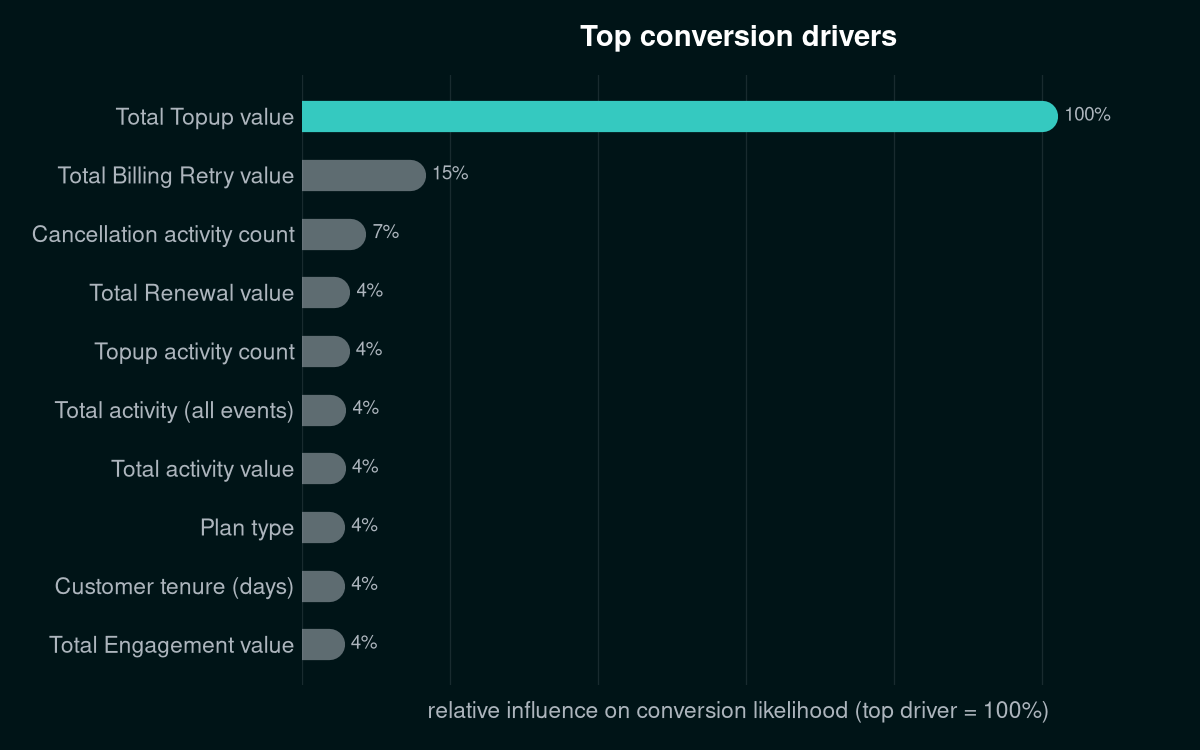
Why the ranking matters more than the rate. A campaign aimed at the top band reaches roughly three buyers for every one a blanket campaign finds, and stops spending offers on customers who were never going to take them. That difference is what a fixed promotional budget actually turns on.
Three things worth being clear about.
No customer of ours appears in these reports. Each dataset is generated to reproduce the messiness of a real book of business: probabilistic behaviour, uneven engagement, decoy customers who look ready to buy and never do. It is not toy data tuned to make the model look good.
The report does not claim a euro value for the upside, because that depends on your pricing and margins rather than on anything in the data. What it does establish is how concentrated the opportunity is, which is the part a model can actually settle.
We send the report, and one follow-up asking whether you want this run on your own data. That is it. No newsletter, no sharing with anyone, and replying "no thanks" ends it.
Pick an industry, enter your email, and the matching cross-sell diagnostic is on its way in about a minute.
Design Partners get the same diagnostic run on their actual data at first-mover terms. Cross-sell is provable the same way churn is: we seal a prediction of who converts next, declare the accuracy we expect in writing, and open it against what actually happened 30 days later.
Book a 30-minute callPrefer to write first? contact@keelshift.com